AP Physics 1
Units
Each ring shows your mastery of that unit's lessons.
What each lesson includes
Lessons
Core notes, an in-depth section, two or three step-by-step worked examples, common mistakes, exam tips, and the Cutnell & Johnson sections to read.
Mastery levels
Not started, Attempted, Familiar, Proficient, Mastered. Practice sets raise a lesson's level; a score under 50% lowers it.
Simulations
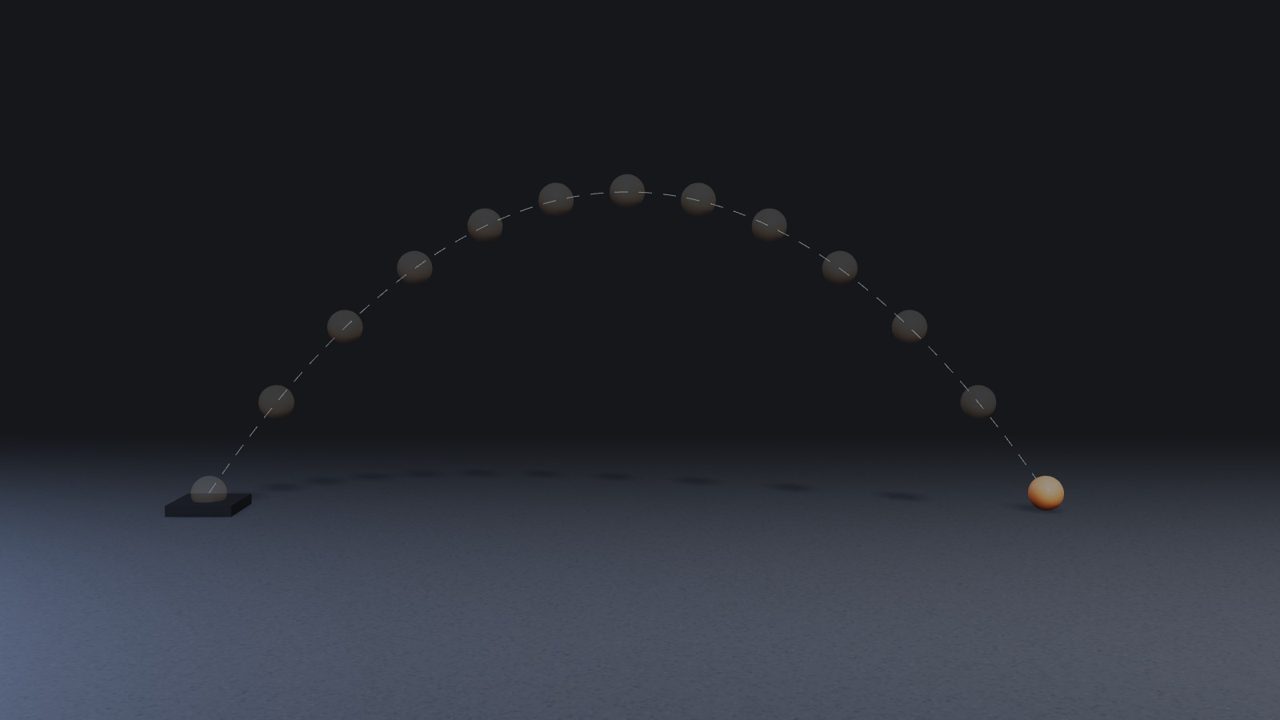
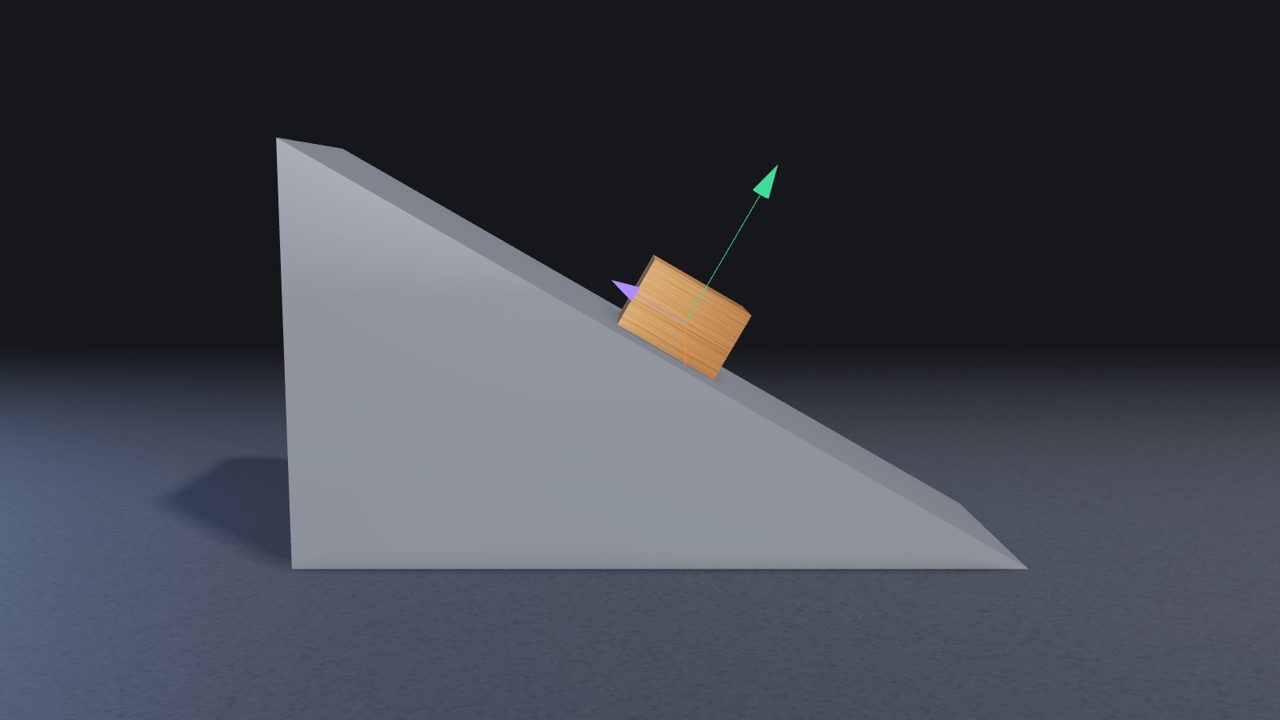
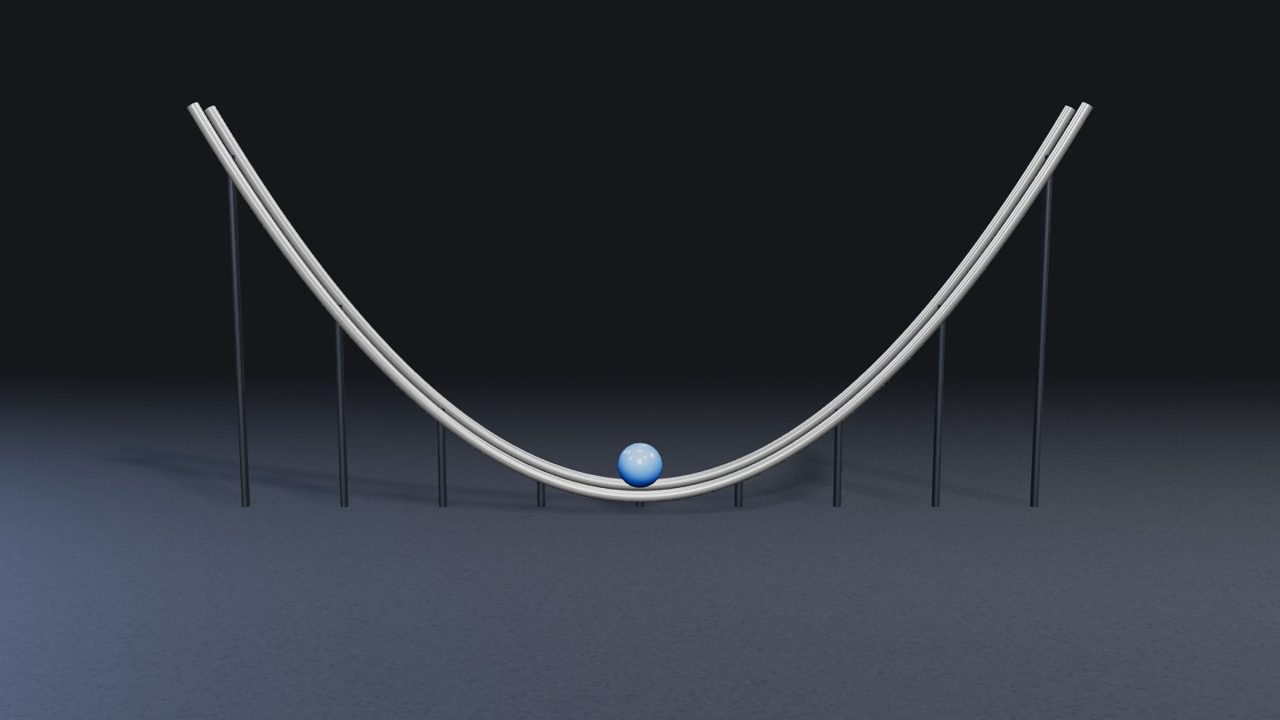
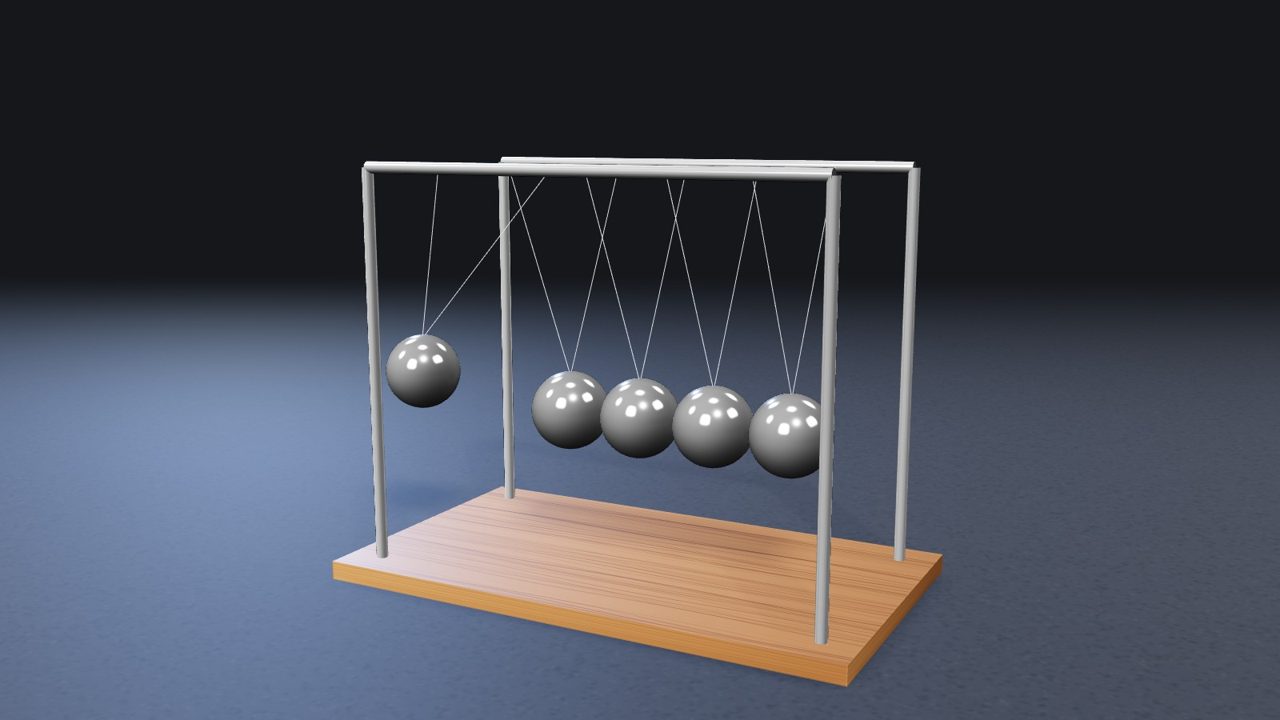
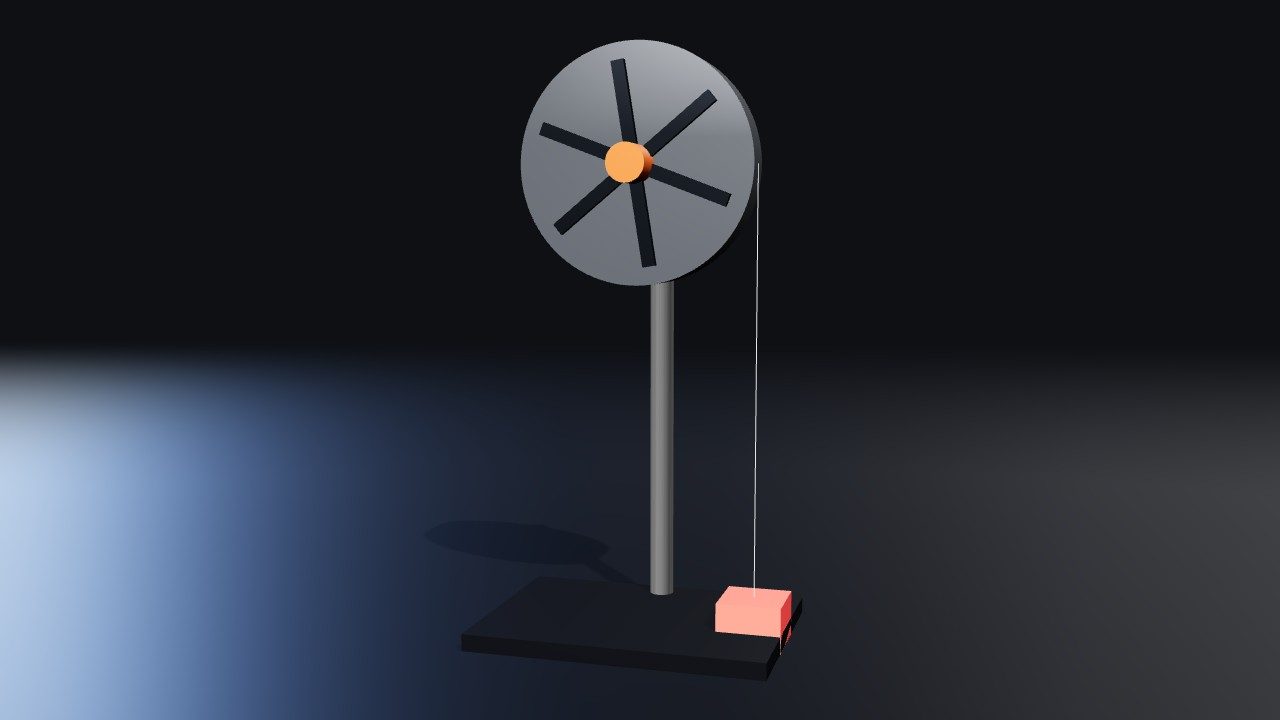
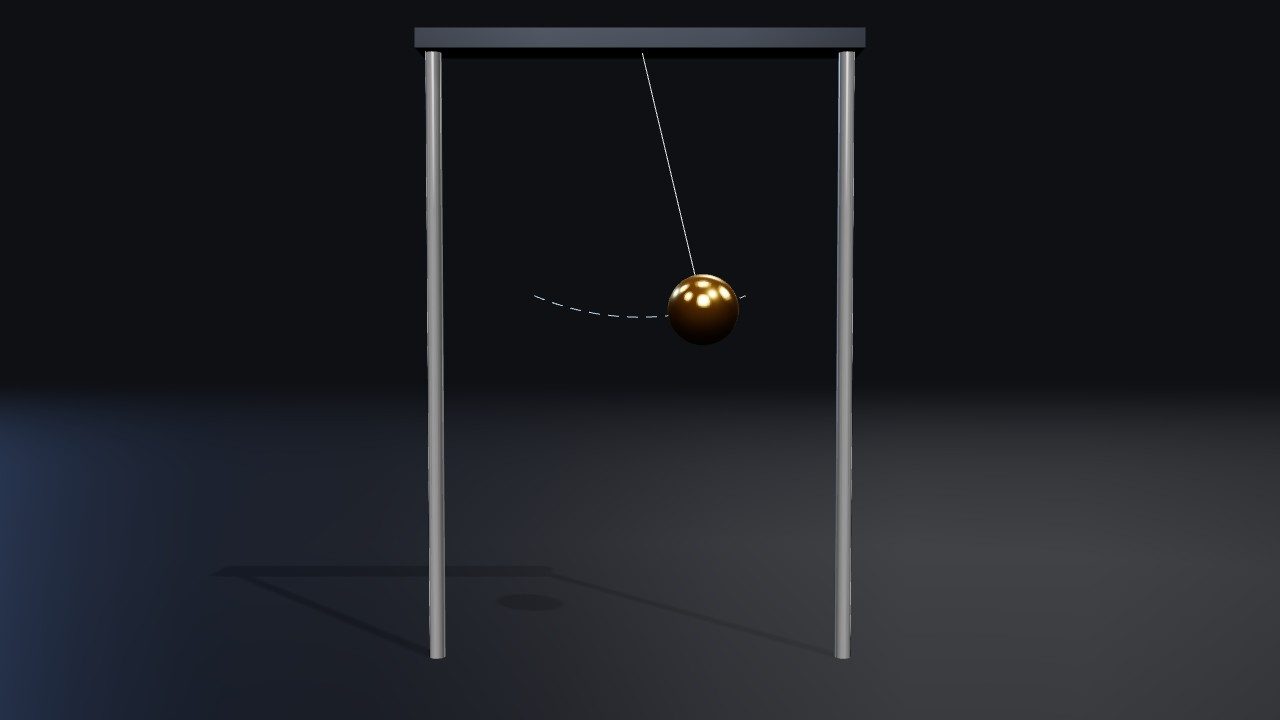
One per unit: projectiles, inclines, energy, collisions, torque, rolling, springs, and buoyancy.
Generated practice
Number problems with new values every time, plus Claude-written question sets, mistake explanations, and FRQ grading in the Claude app.
Full exam
42 questions, 85 minutes, in the published unit weighting, graded at the end.
Unit clips

Course
Eight units, 41 lessons. Each square is a lesson, colored by your mastery level.
Kinematics
Lessons
Overview and simulation
Kinematics describes motion without asking what causes it. You track position, velocity, and acceleration, and you move between equations, graphs, and motion diagrams for the same event.
The central fact for projectiles: horizontal and vertical motion are independent. Horizontal velocity stays constant with no air resistance. Vertical motion has constant acceleration g downward, the same on the way up, at the top, and on the way down.
- Slope and areaSlope of x(t) is velocity. Slope of v(t) is acceleration. Area under v(t) is displacement. Area under a(t) is change in velocity.
- Vectors versus scalarsDisplacement and velocity carry direction. Distance and speed do not. A round trip has zero displacement and nonzero distance.
- Reference framesVelocity depends on the observer. vA rel C = vA rel B + vB rel C.
- Top of the arcvy = 0, vx is unchanged, acceleration is still g downward.
Projectile launcher
LiveChart: height y (blue) and vertical velocity vy (orange) against time. g = 9.8 m/s². Faded curves are your last four launches; turn on air resistance to compare.
Video lessons
Opens Flipping Physics in a new tabForce and Translational Dynamics
Lessons
Overview and simulation
Forces explain why velocity changes. Every problem starts with a free-body diagram: one dot for the object, one arrow per force, each force exerted by a named object. Then sum forces along each axis and apply Newton's second law.
The unit also covers systems and center of mass, friction, springs, circular motion, and gravitation. In circular motion, the centripetal force is never a new force. It is the net inward component of forces you already drew.
- First lawZero net force means constant velocity, including at rest.
- Second lawasys = ΣF/msys. Choose the system to hide internal forces you do not need.
- Third lawForce pairs act on different objects, have equal magnitude, opposite direction, and the same type. Weight and normal force are not a pair.
- FrictionStatic: fs ≤ μsFN, only as large as needed. Kinetic: fk = μkFN.
- GravitationF = Gm₁m₂/r². Near Earth's surface this reduces to mg.
Inclined plane
LiveOne μ is used for static and kinetic friction to keep the model simple. The block stays put when tan θ ≤ μ.
Video lessons
Opens Flipping Physics in a new tabWork, Energy, and Power
Lessons
Overview and simulation
Energy turns many force problems into bookkeeping. Pick a system, list the energy it starts with, add the work done on it by outside forces, and set that equal to the energy it ends with.
Only the component of force parallel to displacement does work. A normal force on a block sliding across a floor does zero work. Friction converts mechanical energy into internal (thermal) energy of the surfaces.
- Work-energy theoremWnet = ΔK. Works for any object treated as a point.
- Conservative forcesGravity and springs store energy as U. Work they do depends only on start and end points.
- Energy bar chartsDraw K, Ug, Us, and ΔEint before and after. FRQs ask for these.
- PowerRate of energy transfer. P = W/Δt = Fv when force and velocity are parallel.
Energy track
Live1 kg ball on a frictionless-to-rough bowl. Chart: kinetic (blue), gravitational (green), thermal (orange) energy against time.
Video lessons
Opens Flipping Physics in a new tabLinear Momentum
Lessons
Overview and simulation
Momentum p = mv is a vector. A net external impulse changes it. If the net external force on a system is zero, the system's total momentum stays constant, no matter how violent the interaction inside.
Collisions split into types by what happens to kinetic energy. Momentum is conserved in all of them. Kinetic energy is conserved only in elastic collisions. When objects stick together, the most kinetic energy is lost.
- ImpulseJ = FΔt = Δp, the area under a force versus time graph.
- Stretching the timeAir bags and bent knees spread the same Δp over more time, which lowers the average force.
- Center of massWith no external force, the center of mass velocity stays constant through any collision or explosion.
Collision track
Livee = 1 is elastic, e = 0 means the carts stick. Total momentum bars match before and after for every e.
Video lessons
Opens Flipping Physics in a new tabTorque and Rotational Dynamics
Lessons
Overview and simulation
Rotation runs on the same logic as Unit 2 with new variables. Torque plays the role of force, rotational inertia plays the role of mass, and angular acceleration plays the role of acceleration.
Torque depends on where and at what angle a force is applied. Push at the hinge and nothing turns. Push perpendicular at the far edge and you get the most torque. Rotational inertia depends on how far mass sits from the axis, so a hoop resists spinning more than a disk of equal mass and radius.
- Rotational kinematicsω = ω₀ + αt and the rest of Unit 1, with θ, ω, α in place of x, v, a.
- Static equilibriumΣF = 0 and Στ = 0 about any point. Pick the pivot that removes the most unknowns.
- Parallel axis theoremI = Icm + Md² for an axis a distance d from the center of mass.
Seesaw balance
Live4 m beam, 10 kg, pivot at center. Find the right distance that makes net torque zero. Hint: 30 × 2 = 40 × d.
Video lessons
Opens Flipping Physics in a new tabEnergy and Momentum of Rotating Systems
Lessons
Overview and simulation
A rolling object stores energy two ways: translational K = ½mv² and rotational K = ½Iω². When it rolls without slipping, v = Rω links them, so an object with more of its mass near the rim spends more of its energy spinning and less moving forward.
Angular momentum L = Iω is conserved when no net external torque acts. A skater pulling in her arms lowers I, so ω rises. Her rotational kinetic energy rises too, supplied by the work her muscles do.
- Rolling raceWrite I = βmR². Then a = g sin θ/(1 + β). Mass and radius cancel. Sphere (β = 2/5) beats disk (1/2) beats hoop (1).
- Angular impulseτΔt = ΔL, the rotational twin of FΔt = Δp.
- Point particleL = mvr⊥ for a particle passing an axis.
Rolling race
Live3 m ramp. Bars show the share of kinetic energy that goes into forward motion for each shape.
Video lessons
Opens Flipping Physics in a new tabOscillations
Lessons
Overview and simulation
Simple harmonic motion happens whenever the restoring force is proportional to displacement and points back toward equilibrium. A mass on a spring and a small-angle pendulum both qualify.
Period depends on the system, not the amplitude. For a spring, a heavier mass oscillates more slowly and a stiffer spring faster. For a pendulum, only length and g matter. At equilibrium speed is largest and acceleration is zero. At the turning points speed is zero and acceleration is largest.
- Energy in SHMTotal E = ½kA² trades between kinetic and spring energy every quarter period.
- Graphsx(t) is a cosine, v(t) is shifted a quarter period, a(t) is the negative of x(t) scaled by ω².
- Frequencyf = 1/T, ω = 2πf.
Mass on a spring
LiveFrictionless floor. Chart: position x against time over the last 6 seconds.
Video lessons
Opens Flipping Physics in a new tabFluids
Lessons
Overview and simulation
Fluids moved into Physics 1 with the course revision. Pressure is force per area and grows with depth in a fluid at rest. The pressure difference between the top and bottom of a submerged object produces the buoyant force.
For moving fluids, two conservation laws do the work. Continuity conserves mass flow: a narrower pipe means faster flow. Bernoulli's equation conserves energy per volume: where an ideal fluid moves faster at the same height, its pressure is lower.
- ArchimedesBuoyant force equals the weight of the fluid displaced. A floating object displaces its own weight.
- Floating fractionFraction submerged = ρobject/ρfluid.
- Absolute versus gaugeP = P₀ + ρgh is absolute. ρgh alone is gauge pressure.
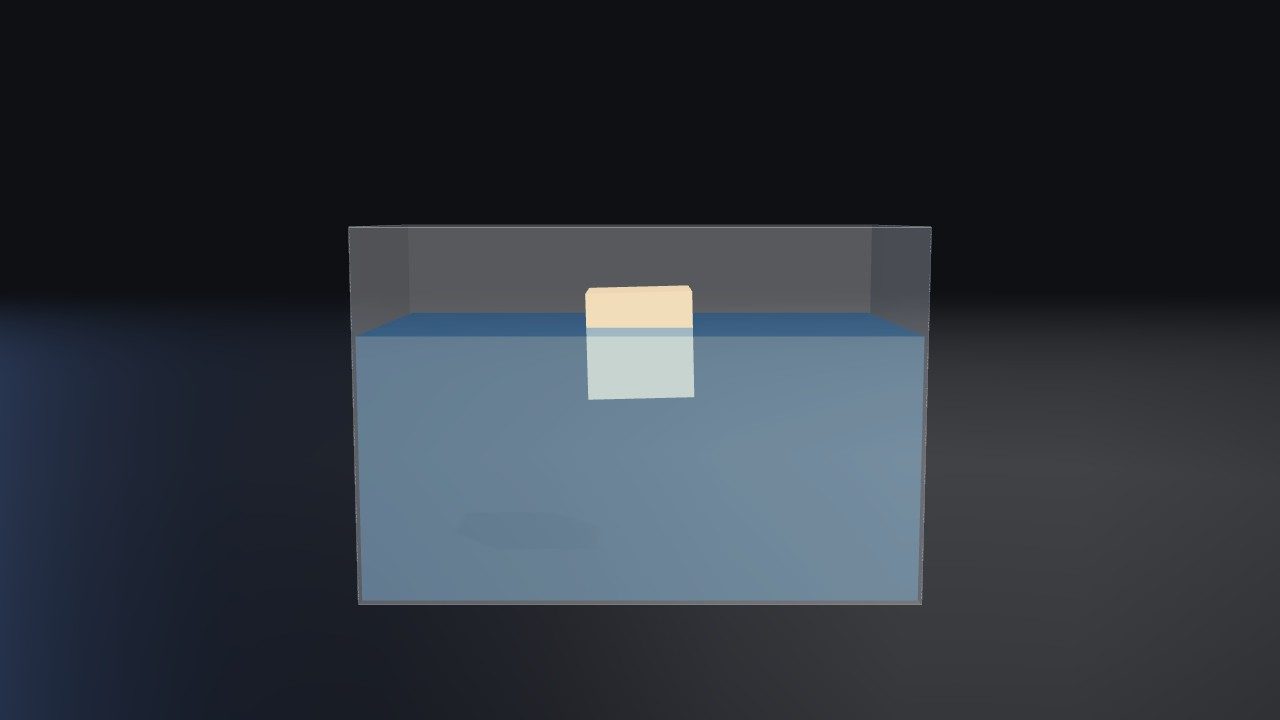
Buoyancy tank
LiveCube of side 0.2 m (V = 0.008 m³) dropped into a 1 m deep tank. g = 9.8 m/s².
Video lessons
Opens Flipping Physics in a new tabPractice
Pick a unit or a lesson. Sets mix written questions with generated number problems. Practice mode checks each answer; quiz mode grades at the end. Both update your mastery.
Full practice exam
Starting in 2027, the multiple-choice section has 42 questions in 85 minutes, and free response runs 95 minutes. Multiple choice is answered in Bluebook; free responses are handwritten.
85 minutes, 50% of the score, four choices each, single select.
95 minutes, 50% of the score: mathematical routines, translation between representations, experimental design and analysis, qualitative/quantitative translation.
Free-response questions
Eight original questions in the four 2027 FRQ types, one per unit. Write your answer, open the scoring guide, and tick each point you earned. With the Claude app, Claude can grade your written answer against the guide.
Formulas
Equations by unit. An equation sheet is provided on exam day.
Kinematics
x = x₀ + v₀t + ½at²
v² = v₀² + 2a(x − x₀)
Dynamics
|f| ≤ μ|FN|
Fs = −kΔx
ac = v²/r
Fg = Gm₁m₂/r²
Energy
K = ½mv²
ΔUg = mgΔy
Us = ½kx²
UG = −Gm₁m₂/r
P = ΔE/Δt
Momentum
J = FΔt = Δp
xcm = Σmx/Σm
Rotation
θ = θ₀ + ω₀t + ½αt²
τ = rF sin θ
Στ = Iα
I = Σmr²
I = Icm + Md²
Rotating systems
L = Iω
L = mvr sin θ
ΔL = τΔt
Oscillations
Ts = 2π√(m/k)
Tp = 2π√(ℓ/g)
x = A cos(2πft)
Fluids
P = F/A
P = P₀ + ρgh
Fb = ρVg
A₁v₁ = A₂v₂
P₁ + ρgy₁ + ½ρv₁² = P₂ + ρgy₂ + ½ρv₂²
Videos
Review videos for the current course from Flipping Physics, sorted by unit, plus Khan Academy's free AP Physics 1 course.
Progress
Privacy.
Last updated November 20, 2026. This site is a study guide. It has no ads and no analytics.
What is stored
- Progress: skill levels, answer counts, and FRQ self-scores. Inside the Claude app it syncs to a private record only you can read; nobody else on the page, including its owner, can see it. Elsewhere it is kept in this browser if you accept storage, or only for this visit if you do not.
- Theme and cookie choice, saved in local storage if you accept.
The site sets no HTTP cookies.
AI features
When you generate questions, ask the tutor, request an explanation, or ask for FRQ grading, the text you write and the relevant lesson content are sent to Claude to produce the answer. Nothing else is sent.
What is shared
Fonts load from Google Fonts and the 3D library from cdnjs (Cloudflare). Like any web request, these providers receive your IP address and browser details.
Your controls
Use Cookie settings in the footer to change your choice. Reset progress on the Progress page. Clearing site data removes everything in this browser.
Content
Lessons, questions, and FRQs are original. Book references point to section numbers in Cutnell & Johnson, Physics, 10th edition; no book text or problems are reproduced. Videos and images are 3D renders made for this site.